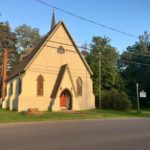
 On July 14th, I attended a rendition of “Snow White and the Seven Dwarfs,” put on by the Children’s Glassworks Theatre in Cleveland, New York. The Children’s Glassworks Theatre is a free program where children ages six to sixteen can perform in community plays directed and produced by local resident, Marge Thomas. This program allows children to gain experience in performance arts and set designing that they may not otherwise have.
The hot and humid day led into a hot and sticky evening. Knowing that the 7:00 pm performance would be packed, my husband, daughter, and I pulled onto the normally quiet street that the decommissioned St. John’s Episcopal Church resides on a half hour before the play was scheduled to begin. The street was already packed with cars parked bumper to bumper along both sides, making it difficult for any passing traffic to get through. The yard surrounding the church where the theatre is housed was also completely full. Luckily, we were friends with a neighbor and parked in their driveway. As we walked up to the church, we were greeted by other community members saying hello and asking how we were doing. Everywhere you look, people were laughing and hugging as if they haven’t seen each other in years, even though most of them see each other on a regular basis in the grocery store or at church.
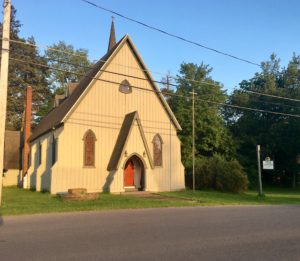
The sun beating down was hot and the air was thick with humidity. Even though the line was short to get into the building, where we would purchase our tickets, it felt like it took forever to get inside. The entrance into the church allowed little shade. Upon entering the church to purchase our tickets, we realized that although we would escape the heat from the sunshine, we would not do the same from the humidity. St. John’s church was built just after the Civil War, its high-pitched ceilings not conducive for heating and cooling the space. Inside the sanctuary, where we would sit to watch the performance, rows of the original pews lined both sides of the room with a red, carpet runner creating a pathway up the middle between the pews leading to the former pulpit where the stage had been constructed. The room smelled old and stale, which was assisted by the lack of air flow and humidity. Props could faintly be seen on the darkened stage. The pews were almost completely full, so we found seats towards the back of the room. Our seats didn’t allow for the best viewing, but I had hoped it’d do.
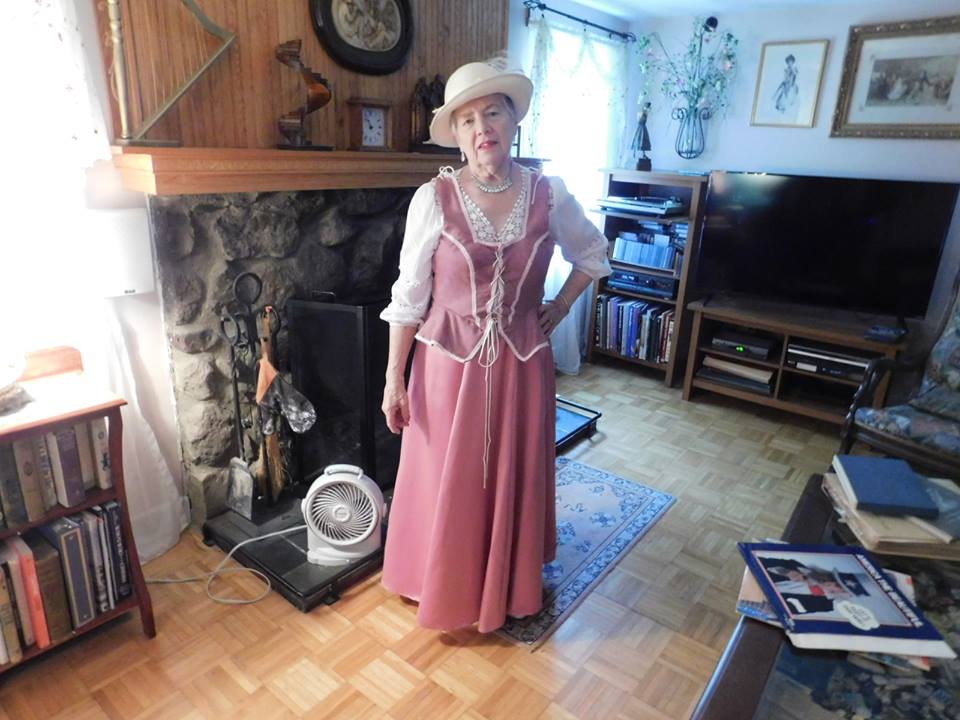
At 7:00, the lights lit up the stage and Marge Thomas appeared in a pink and white long dress with matching vest and hat. The dress appeared to have ruffles and lace, and reminded me of a dress that women might have worn in the 1800s. Although she must have been roasting in her dress, Marge appeared to be as cool as a cucumber. She opened the show by thanking everyone for attending and apologizing for their being no air conditioning. She also offered cushions for anyone that was interested, as the pews were very hard. Marge then explained that the theatre was started and hosted by the Cleveland Historical Society in 2004 in order to bring the Arts into the children’s lives. Marge also spoke of how many of the plays that did were considered to be fractured fairy tales. After she thanked everyone again, the stage went dark.
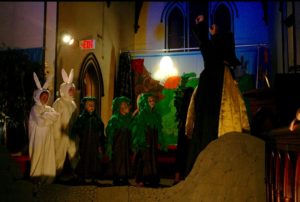
One red spotlight lit up the right side of the stage as a young girl dressed in red, wearing piggy tails in her hair began to quickly tell the story of “Snow White and the Seven Dwarfs.” When she finished her lines, the light changed to blue and another piggy tailed girl in blue stood up and continued with the opening narration. The light changed color a third time, to green and a third young narrator stood up in a green shirt wearing matching piggy tails. When the narrators finished, the light turned off for a moment before illuminating center stage where a tall, oval, swiveling mirror stood alone. A young girl dressed in dark robes loudly says in a shrilling voice “Mirror, mirror, on the wall. Who’s the fairest of them all?”
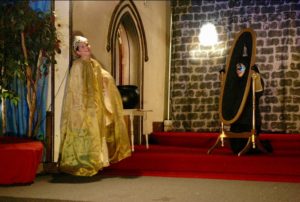
As we sat on the wooden pews, we watched the children of the Glassworks Theatre, regal us with a story of a young princess whose mother passed away, leaving her father to remarry so that she would have a mother. Although it is never said in this version of “Snow White and the Seven Dwarfs,” her father is absent, presented to have passed away as well, leaving the princess to live as a servant for the queen. The queen is content with being the “fairest in the land,” according to her magical mirror…. until one day when the mirror admits that princess Snow White is much fairer than she is. The queen goes into a jealous rage, ordering a huntsman to kill the princess, bringing back her heart as proof. The huntsman guides Snow White into the woods but is unable to carry out her death. Instead, he begs her to stay in the forest and returns with a sealed box containing a rock. The mirror agrees to never tell the queen that Snow White still lives. Snow White finds solace living deep in the forest with seven miners. As they work in the diamond mines all day, she cooks and cleans for them. She finds comfort in the friendships she made with the forest animals. As the play continues, a prince sees her playing with the animals and becomes enamored with her. The mirror slips and lets it out that the princess is still alive. The furious queen tracks down the princess and tricks her into eating a magical apple that puts her into a deep sleep.
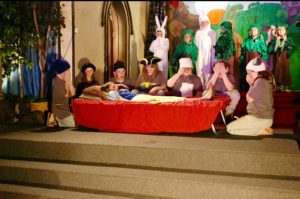
The miners and prince find her sleeping and the animals tell them what happened. They track the queen down and scare her into falling off a cliff. The queen’s death instantly releases Snow White from her deep sleep. The prince asks her to marry him. The play ends as the prince and Snow White are saying their vows. As she is asked if she will marry the prince, Snow White yells “NO WAY” and runs own the isle. As she runs away, the lights go dark and the play ends. The room is filled with a thunderous applause as the lights come back on.
Before attending the performance, I had the pleasure of interviewing Marge Thomas on her volunteer work with the Children’s Glassworks Theatre. I feel that interviewing her prior to the play, gave me an insight as to why she devotes so much of her time to the theatre. This allowed me to truly appreciate both the production seen on stage, but also all of the workings behind the scenes that most people don’t realize happen.
 You wouldn’t know that it was a cool and dreary day when stepping into the high school cafeteria. There was a loud chatter of people everywhere that warmed the atmosphere. The room was packed with family members, friends, teachers, and community members- all looking at student artwork. The lunchroom no longer looked like a lunchroom. Instead, it was transformed into a makeshift gallery. six by four foot black felt boards lined the walls. Each board contained dozens of student artworks that ranged from pencil and charcoal drawings to chalkings and paintings. There were tables set up with countless sculptures of metal and ceramics. Other tables were layered with photographs of flowers, sunsets, various objects like pencils and crayons, people and animals. It was exciting to see all of the students’ art work on display for all to see. Above the crowd, I could hear a familiar high pitch laugh. Without seeing her, I knew exactly where my niece was- I’d know her giggles anywhere. I followed the sound of her voice and found myself standing in front of a six foot tall black felt board with a dozen and a half pieces of art, and my niece beaming from ear to ear. This is exactly what I came to see!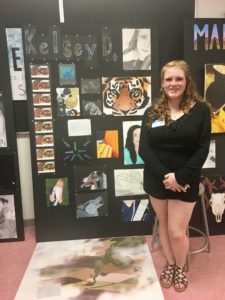
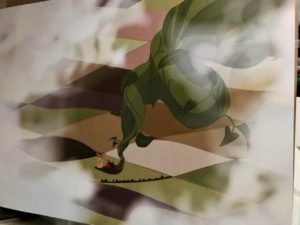 In front of Kelsey’s board, on the floor lay a two by three foot piece of white canvas. On it, a scene of brown and green rolling hills with a beanstalk flowing from the corner, surrounded by white clouds. It was a scene from Jack and the Beanstalk. The piece was designed from the perspective of the giant looking down on Jack as she climbed down to the country side. At first glance, the canvas looked to be painted but after closer examination, I realized that it was a digital rendition of one of her paintings. As it turns out, Kelsey originally drew this design for the school’s Varsity Winter Guard team to use as their floor mat for their performance of Jack and the Beanstalk. I had seen the larger, full size version of this during their performances but never knew she had designed it. Seeing it and putting it together blew my mind!
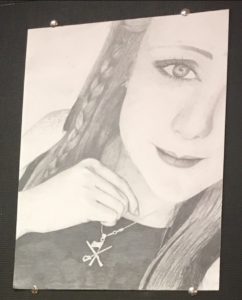 Her ability to shade in even the smallest details such as her eye brows and eye lashes down to the light reflecting from her necklace was amazing. Another self-portrait was displayed in the opposite corner. This one drawn in oil-based chalk was of her and the rifle she spins during Winter Guard performances. Half of her face is hidden behind the butt of the bright white riffle, but looking in her eyes it’s clear that she is smiling. A pencil drawing of a broken light bulb was displayed below a portrait of a girl with long brown hair putting on stage makeup. As I looked at this painting, I noticed the smallest details that Kelsey managed to include, such as the girl’s stray curls in her hair and the wrinkles in her sky blue shirt. Mindfully scattered on the board were pictures of different animals that Kelsey drew. Elephants, leopards, dogs, and wolves; but the most prominent one was of a tiger.
 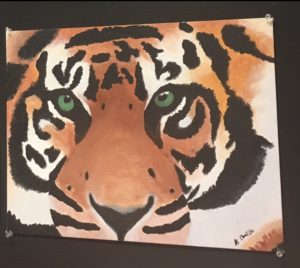 The orange, white, and black face took up the entire piece. Its stripes perfectly spaced around his nose and bright green eyes that pulled you in and held your attention. If you stared for too long, you could easily forget that you were looking at a piece of 8 by 11 card stock and water colors. Viewing her display, it was easy to see what Kelsey valued most.
 It’s difficult to walk around our little town without hearing about something that Marge has done for our community, so it’s no surprise to hear that she pretty much runs the