The New York State Chinese Lantern Festival: Experiencing Education

In the evenings between April 14 and June 24, 2017 hundreds, if not thousands of people flocked to the NYS Fairgrounds located in Syracuse, NY in order to attend the New York State Chinese Lantern Festival. The purpose of this event was to bring awareness of the Chinese culture to the residents of Upstate New York. The event allowed its visitors of all ages an opportunity to experience a culture that is new or different to the one that they live in.

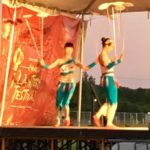
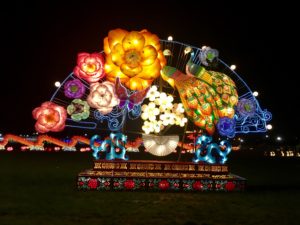
The actual Chinese Lantern Festival traditionally takes place at the end of the Chinese Spring Festival (aka the Chinese New Year Festival), on the night of the first full moon of the Chinese calendar (typically in February or March). The Chinese New Year Festival is considered to be the most important festival because it symbolizes the reunion of family as spring returns. As us “Upstaters” know, New York is usually cold and snow covered during this time which makes it nearly impossible to display the lanterns outside on the fairgrounds. For this reason, the exhibit ran from April through June, allowing visitors 2 months of warmer, less snowy weather to attend and appreciate the history behind the larger than life lanterns. The festival consisted of more than 30 lit up displays aligned along a mile-long path around a small pond that attendees could walk, take photos, and read informational placards in order to learn more about the significance of some of the lantern displays. It took months for the artisans from Sichuan, China to make and assemble the lantern displays at the Fairgrounds. Along with the lanterns, there were also nightly stage performances that consisted of acrobatic contortion, plate spinning, and face changing.
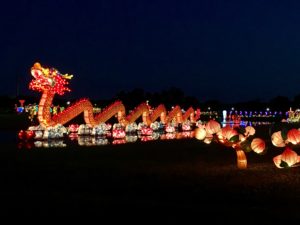
On June 21st, two of my daughters and I headed out to the Fairgrounds, in Syracuse to attend the Festival. Arriving around 8:30 in the evening still allowed enough daylight to watch the stage performances but late enough to enjoy the sculptures fully lit up in the dark. Driving into the parking lot, it was impossible to miss the huge 200-foot lit up orange dragon that appeared to be swimming in the center of a pond. Along the outskirts of the pond, dozens of other lit up animals such as penguins, elephants, and giraffes could be seen.
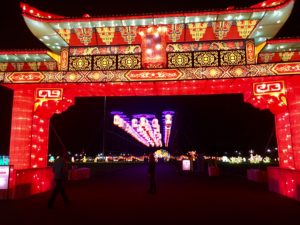
The festival greets its guests as they pass under a giant red welcome gate that resembles a traditional Chinese building. Along with the bright red columns, the gate was decorated with brown, yellow and teal-green designs. Once passing under the welcome gate, visitors walk beneath a corridor of white lanterns with orange foliage painted on them, hanging from rings of purple lights intricately woven into whimsical circles. When walking through this beautiful corridor, it feels as though you’re about to be transported to another world. A colorful field of vibrantly lit decorations lay on the other side of the magical corridor that make it difficult not to get excited about. The mammoth dragon centered in the pond was definitely the largest attention grabber. It’s bright orange body with fire red scales beckons visitors to come to the edge of the pond to see it. To the left of the entrance lays a stage with benches placed in front for audience seating where the nightly acrobatic or plate spinning performances occur.

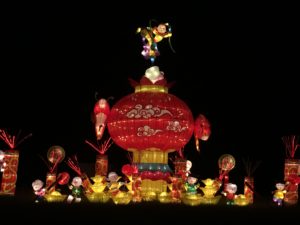
The one mile long path around the pond consists of a colorful menagerie of brightly lit animal shaped lanterns. These whimsical animals included giant elephants, panda bears, fish, zebras, giraffes, and tigers. Along with the animals, there were lantern gardens of tulips, roses, and cherry blossom trees. All of the lanterns contained meaning within the Chinese culture, which could be read on the informational placards that were posted alongside each lantern display. These placards discussed the item on display, its historical value, and it’s meaning in and importance to the culture. Although there were signs posted to stay on the path it was not enforced, making it easy for curious people (such as myself) to walk up to the lantern displays in order to get a better look at the lanterns or to take photos with them. To my surprise the lanterns were made out of a heavy, transparent, vinyl material and sewn together with an upholstery grade thread.


To help visitors immerse themselves deeper into the culture, there were Chinese food concessions onsite that offered delicious foods such as dumplings, teriyaki, and eggrolls. Artisans also had vending booths set up, selling authentic paper lanterns and stars, fans, and parasols. There was also a booth where guests could get their names written in traditional symbols.

The most prominent theme noted throughout the Lantern Festival was the use of animals and fish throughout the displays. Each animal used held important meaning to the Chinese culture. One example is the use of fish and other sea life creatures. So much of the traditional Chinese culture relied on fishing for survival which made their representation important. The pronunciation of fish in the Chinese language is the same as “surplus” which meant people could have wealth and food for the upcoming year. Another example is the use of the dragon which was important because it represents a spiritual symbol of all Chinese people that ties the entire Chinese nation together.

The intention of the festival organizers was to share the Chinese culture and traditions with the public who may not otherwise have the opportunity to do so in such a realistic environment. The organizers did a great job of doing this by posting informational placards about the importance of each specific display along with its meaning and importance to the culture next to the various lanterns for people to view at their leisure.

I enjoyed attending the Lantern Festival because it allowed me the opportunity to learn about and deeply experience a culture different than my own and I believe that other festival goers would find the same experience. The festival did a fantastic job of educating its visitors by providing informational placards next to each lantern display, along with including authentic food vendors and artisans. Anyone that enjoys learning through visual representation or those who just enjoy experiencing new or unique things would enjoy walking the festival, taking in all of the larger than life exhibits. The New York State Chinese Lantern Festival isn’t just for those yearning to learn more about the Chinese culture. People of all ages will enjoy getting lost in the beautiful lit up displays.
https://www.syracusenewtimes.com/

Works Consulted:
China’s Lantern Festival — Traditions, Activities. Retrieved from https://www.chinahighlights.com/festivals/lantern-festival.htmChinese Lantern Festival (2017). Retrieved from http://www.yourchineseastrology.com/holidays/lantern-festival/Chinese New Year (2017). Retrieved from http://www.history.com/topics/holidays/chinese-new-year
Marge Thomas and the Children’s Glassworks Theatre

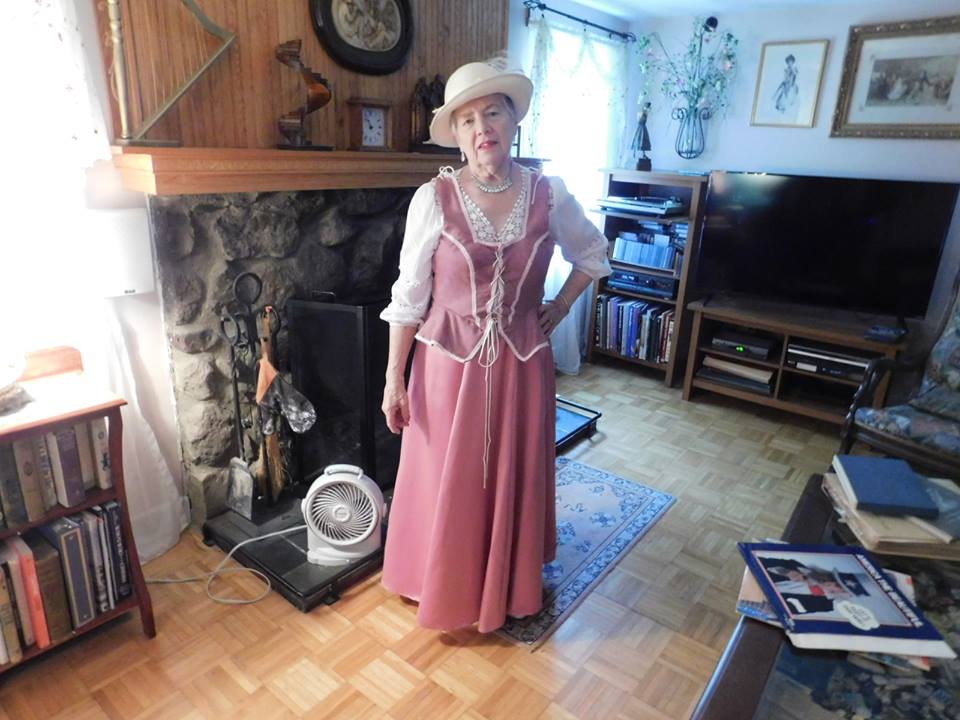
I’ve known Marge Thomas for many years. She has been a member of our community in Cleveland, New York (located on the North Shore of Oneida Lake) for almost 65 years; volunteering in our churches, the American Legion, the elementary school, and the Cleveland Historical Society. It’s difficult to walk around our little town without hearing about something that Marge has done for our community, so it’s no surprise to hear that she pretty much runs the Children’s Glassworks Theatre, single handedly through the Historical Society. The Children’s Glassworks Theatre is a free program for children between the ages of 6-16. Marge works with the children to help them enhance their acting skills so that they can put on various plays throughout the year.

I recently had the opportunity to sit down with Marge to talk about her involvement with the Children’s Glassworks Theatre. Arriving at her home on a warm Monday evening, I was greeted after my first knock on her purple front door by her husband, Dave. The sound of music from another time (maybe the 40s or 50s) played an enchanting melody from one of their antique record machines. After our hugs and kisses hello and asking how the family is doing, he leads me into his living room where Marge is waiting for me. She hugs me, and begins to tell me how it was the first day of her Drama Camp. Drama Camp is a week long program where the children of the cast spend their time perfecting their roles and the scenes for the upcoming performance.

As I look around the room, there are photos of Marge’s family- her children, her grandchildren, and the children of the community that she has adopted as her own scattered in every direction. Love is felt everywhere. She offers me a drink and a plate of cookies because “I look like I’m fading away to nothing.” I’ve learned a long time ago that you cannot say “no” to Marge Thomas. It is simply impossible, so I have no choice but to happily accept her delicious homemade chocolate chip cookies as I begin to ask her about the theater program and her involvement in it.

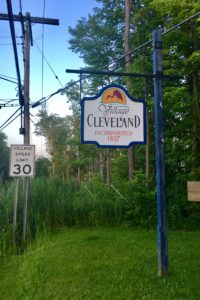
Cleveland Historical Society sign posted outside of St. John’s Church. (Cleveland, NY 2017)
St. John’s Episcopal Church where the Children’s Glassworks Theatre is housed. (Cleveland, NY 2017)


What made you want to get involved with the Children’s Glassworks Theatre program?

The children. We live in a financially poor, rural area that doesn’t have a lot of things for kids to do outside of school. We now have a soccer league and a baseball and basketball league but not all children are athletic. I wanted to find something that all kids could do regardless of their athletic ability. A lot of parents work and don’t have the time or resources to do things with their kids, so the theater gives the children in our community something to do. It also opens them to an experience that they may not get otherwise.

How long have you been producing/directing these performances?

We’ve been producing plays since 2004. We’ve done Jack and the Beanstalk, Cinderella, The Legend of Sleepy Hollow, a derivative of The Wizard of Oz, and a lot more. There’s so many.

Do you direct and produce the plays by yourself?

Kristen, I’m good, but even I need a little assistance. My husband, David is amazing. He helps wrangle all of the kids. He has ideas, and helps with set designs. I also have one or two parents volunteer too. They help me direct the children and help them practice their roles.

How many children do you typically work with and are they always the same children?

I work with anywhere from 5 to 30 children. For a range of years, I’ll have the same children, until they get too old or become involved in other activities, but I always have new children too. Younger siblings tend to join the ranks. As the kids become involved and tell their friends, their friends join too.

Has there ever been a time where you’ve had to turn kids away because you didn’t have enough roles for all of them?

No child will ever be turned away. There is always room to fill. Sometimes, I’ll get creative and turn one character into a group of characters. In Cinderella, I needed mice so instead of 3 mice, we had 5 mice. I needed a pumpkin patch so I children acted as a pumpkin patch. The children also help with decorating sets. There is always something for everyone to do.

Have you ever had a year where you didn’t have enough children to perform a chosen play?

No. We’ve had years where we’ve only had 5 or 6 children, but I just give them extra roles. Not multiple BIG roles, but sometimes, I’ll have them be two different characters. Or I’ll just cut characters out, if they aren’t as important to the story line. You know this. Your daughter has performed a few times where she was a few different characters. That is always fun to see. It’s nice to see exactly what they can do and how far they can stretch their talent. Too many or not enough kids, I can improvise and make anything work.

What is your favorite part about directing/producing these plays?

I love working with the kids. They are my favorite part. I love the kids that have done it a few times and know what to expect and I love the kids that have never acted or performed before. Watching them realize that they can perform is wonderful. It brings joy to my heart.

What is the most difficult thing for you?

The hardest part is making sure that we have enough funding to put on the show.

How does it work? If it’s a free program, how do you obtain the costumes and set designs?

It’s a free program for the children, I would never charge them- but it’s not truly free. The Children’s Glassworks Theatre is sponsored by the Cleveland Historical Society. We are lucky enough to use St. John’s Episcopal Church as our theater. The church was decommissioned some years ago, and the Historical Society took it over. With the help of some of our community members, we were able to build a stage where the children perform and practice their plays. The Historical Society keeps the heat and lights running for us. We rely heavily on donations. Vella’s Hardware is always willing to loan us set supplies like boards and lumber. We try to not abuse them too much so that we can re-use them in the future or give them back. Costumes! Depending on the character, I ask the children to bring in specific items from home…. pants, or white dress shirt, a skirt or dress of a certain color. Then I’ll alter them a little to better fit the character. I’m a seamstress. I love to sew. If I need to, I’ll sew costumes.

What about the plays? Do they cost anything?

Oh yes…. there are copyrights that I need to pay for in order to use them. I apply for grants from Oswego County and New York State. Knock on wood, we’re fortunate enough to usually receive the grants I apply for. We also receive donations from community members. We live in a wonderful community that loves their kids.

How often does the Children’s Glassworks Theatre hold performances?

We have two performances a year. We do one in July. We hold open auditions in May, a few rehearsals in June and then a week long summer camp that runs from 10am to 4pm, with their show on that Friday night. We also have a performance in December that we start preparing for in the fall, meeting on Sunday afternoons.

How do you decide which play to put on?

It depends. Sometimes, people will contact me with suggestions and other times I go to Oswego County and ask if they have any plays that are available to use.

So you only use pre-written plays?

Not always. I have written a few plays that we have performed. There have been times that past performers have brought me plays that they have written as a project for school, that I’ve used.

What has been your favorite play to date?

It’s difficult to name a specific play. They’re like your children- you don’t have a favorite. You love them all equally.

You must have a few that you enjoyed more than others?

No…. but if I did, it might be Million Dollar Mystery at the Opera House. I wrote it… but that is not why I enjoyed it so much. I liked it because it was an interactive play. The audience participated because it was a mystery and they needed to solve the mystery. The children interrogated them. Accused them. They made them part of the show. It was thrilling! What I really liked about it, was that the children and the audience learned a little about Cleveland’s history. They learned about App’s Opera House… do you remember that? It was torn down almost 30 years ago, but the family that owned it back in its heyday ran an old fashioned projection theater out of it. People came from all over to attend. Cleveland has history and being able to teach the kids about it was wonderful!

There’s even history included in the theater itself. You know why it’s called the Children’s Glassworks Theatre, don’t you? It’s in honor of the glass making factories that used to be on Sand street. Cleveland was famous for its glass making companies until they were shut down in the early 1900’s because of industrialization.

I actually knew this, as it is a pretty big deal in our little village. Glass can still be found in the woods where the old factories used stand.

What’s the next play you’ll be putting on and when will it be?

The next play that the children will be performing is Snow White and the Seven Dwarfs on July 14th. It’s not the Snow White and the Seven Dwarfs that you know. It’s humorous….you HAVE to come and see it! I will not give anything away. If you want to know, then you need to come see it.

Before leaving with a plate full of cookies for my family, I promised Marge that I would in fact come see the Children’s Glassworks Theatre’s performance of Snow White and the Seven Dwarfs. How can I not? I need to see what special twist she has put into this story.

Dave and Marge Thomas (Cleveland, NY 2017)


Boris Artzybasheff: More than Faces on Machines

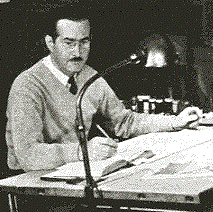
Boris Artzybasheff (1899 – 1965)

Last October, I was invited to attend a lecture at the SUArt Galleries, at Syracuse University on their special collection on the work of an artist that I had never heard of. The artist was Boris Artzybasheff (1899-1965), a Russian born American illustrator widely known for his illustrations in numerous children’s books, along with his work in commercial, advertising, and magazine art.

When I was invited to the lecture, I had no idea who the artist was or the style of his artwork, but I was interested in the possibility of learning something new and expanding my horizons. About twelve freshmen, five doctoral students, and I walked into the Galleries, some of us not sure of what exactly we were about to embark on. We were quietly led through a dimly lit Sendak exhibit into a medium sized room, softly lit with overhead track lights. The walls were lined with waist high built-in cabinets that contained sliding drawers, all neatly labeled in alphabetical order. The walls above the cabinets had artwork mounted along them. As we entered the room, we filed in around a large workspace table centered in the room, also containing sliding drawers labeled in the same fashion as the wall cabinets. Spread across the table was an array of approximately 30 of some of the oddest illustrations that I had ever seen. Some of the images were of airplanes and tanks while others were giant factory machines or household appliances on them. Most of the items in the designs had faces with detailed expressions on them. The poster sized images had a satirical and industrial feel to them, from what I had guessed to be from the 1930s or 40s. I was mesmerized by the images laid out in front of me. As we stood around the table, the curator began to tell us about Artzybasheff and his works. He went into great detail to explain each piece and the meaning behind them. We were encouraged to circulate around the table in order to really take in each piece and ask questions about them.

Artzybasheff’s work In Advertising:

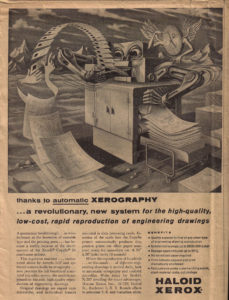
Xerography

In the 1930s, Boris Artzybasheff began illustrating advertisements, many having an anthropomorphic representation to them. Examples of these anthropomorphic advertisements can be seen throughout his career such as the images he illustrated for Xerox when they wanted to promote their new copy machine. Artzybasheff designed an image containing a humanized copy machine happily spitting out hundreds of printed papers. Looking at the piece, the copy machine’s wide eyes appear to be concentrating on the stacks of papers shooting out of her half opened, smiling mouth. Behind the machine, lay stacks of unprinted paper waiting to be printed on. The advertisement gives the sense that the Xerox’s latest machine can make quick and easy work out of a big copy job.

In a time when consumers weren’t entirely comfortable with new technology, Artzybasheff believed that using anthropomorphism for advertising purposes would soften the consumers views of machinery and encourage them to jump on board with the post-war machinery era. In an article published in the Journal of Marketing Management, Patsiaouras, Fitchett, and Saren confer that “In a period of both technological and economic turmoil, Artzybasheff’s ‘man-saving’ anthropomorphic illustrations enticed potential customers to disengage their emotions from traditional methods of labour and catch the technology wave,” (2014).

Ultimately, these advertisements landed Artzybasheff long standing relationships with popular magazines such as Fortune, Life, and Time as a cover artist. From 1940 through 1965, Artzybasheff illustrated more than 200 covers for Time. His magazine illustrations included anthropomorphic images of countries, portraits of leading politicians, scientists, and athletes, and rising technologies.

Artzybahseff’s work in War Propaganda:

At the arrival of World War II, the American government began marketing propaganda in the form of war posters designed by popular artists. This marketing push held the hopes of forming a sense of comradery amongst the American people in order to bolster confidence and glorify their war efforts. Where other artists, such as Norman Rockwell focused their illustrations on idealistic and sentimental scenes of the American life, Artzybasheff’s images “focused on the representation of the enemy rather than the efforts of the federal government and defense industries to promote war bonds, national pride, frugality and recruitment of woman for factory labour,” (Patsiaouras et al., 2014). Examples of this can be found in his series called “Modern War Machines,” published in Life magazine in 1941. In this series, Artzybasheff illustrates war machines and humans morphed together into one object.

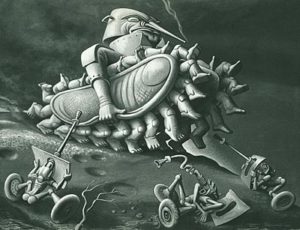
Modern War Machines: Tank

One of Artzybasheff’s well-known pieces from this series, entitled “Tank” was on exhibit at the lecture I attended, and instantly grabbed my attention. The illustration’s focus was what appeared to be a robot type being wearing a tank’s body, running over smaller humanized guns. The robot’s squinted eyes and smoking cannon for a nose gave it an angry appearance. The tanks’ body was a large thumb with two dozen sets of “forward-marching legs (those of German troops) make up the tank’s mechanized tread,” (Willaims, 2007). As if the body of the tank was too heavy to run in, the robot was holding it up with its arms. In the illustration, the massive tank was running over three smaller personified guns, hiding behind steel shields. The facial expressions on these smaller defeated guns made it obvious that they were terrified of the tank. I spent quite a bit of time, literally only minutes that felt like hours, staring at this illustration, feeling sad and broken as I watched the mammoth tank trample the defenseless guns.

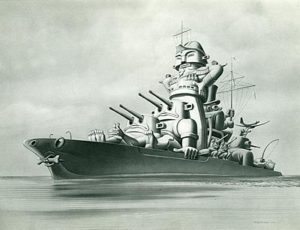
Modern War Machines: Battleship

“Battleship” was another illustration from the same “Modern War Machines” series on display. This image focused on a mechanical Japanese soldier in uniform portraying the center stack of the ship. Humanized masts with cannons for eyes surrounded the soldier, appearing to be on the lookout for their next target as the ship floated through water. As intriguing as the piece of art was, no other images touched me like “Tank” did.

Artzybahseff’s work in America’s Post-War Consumer Culture:

In the post-war era of the 1950s, Artzybasheff began illustrating covers for Time with images of humanized technological appliances such as radios, telephones, and computers with the purpose of attracting consumers to spend money on superfluous household items. As consumers spent more money on such items, the demand also increased.

It can be said that Artzybasheff’s most famous collection of anthropomorphic machines were illustrated during this industrialized and technological time. This collection contains illustrations of humanized machines such as hydraulic presses, electric welders, and mills, to name a few which appear to be making more of the same humanized machines and industrial goods. Each machine shares the same common melancholy look in their eyes and turned down frown on their faces as they perform their routine tasks of replicating the same machine goods over and over. It is within this series, that Boris Artzybasheff allowed his opinions towards America’s industrialization to appear in his illustrations. In an article published in Interdisciplinary Humanities, R. John Williams acknowledges that “Artzybasheff’s work in the 1950s actually seems to reflect a deeper ambivalence about the potentially exploitative possibilities of the machine age,” (2007).

The Executive of the Future

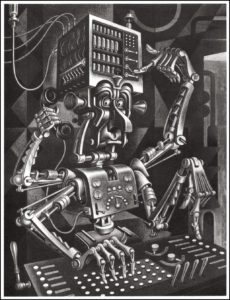
Coming from this era was a second piece of art on display that gabbed my attention from Artzybasheff’s lecture. Originally illustrated in 1952 for Esquire, “The Executive of the Future” was an illustration of a multi-armed robotic being that appears to be frantically doing multiple tasks at the same time, including answering a phone and typing on a futuristic keyboard. The frazzled looking being has circuits for brains located in his oversized head with numerous wires connected to it from other locations, not shown in the illustration. The robot’s tightly pressed lips and sideways downcast eyes give it the appearance of being overwhelmed or unhappy. It can be questioned whether this image represents someone in higher management or a regular middle-class position is unhappily trapped in a futuristic machine. I was drawn to this piece because of the sadness in the robotic being’s eyes. It reminded me of how myself and many others may feel overwhelmed and unhappy by the growing demands needing to be met in our jobs.

After attending the lecture and further researching his work, what really struck me as I explored Boris Artzybasheff’s artwork, was how many of his pieces are still relevant in today’s times even though they were illustrated over 50 years ago… Larger than life bullies forcing their way, their weight on those weaker than them? Society constantly being plugged in and turned out to what’s going on around them?


Works Cited:

Patsiaouras, Fitchett, & Saren. (2014). Boris artzybasheff and the art of anthropomorphic marketing in early american consumer culture. Journal of Marketing Management, 30(1-2), 117. Retrieved from https://search.proquest.com/docview/1498544109?accountid=14214

Williams, R. J.’I like machines’: Boris artzybasheff’s machine aesthetic and the ends of cyborg culture. Interdisciplinary Humanities, 24(1), 120-142. Retrieved from https://search.proquest.com/docview/1427741419?accountid=14214