
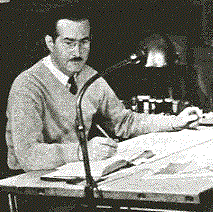
Last October, I was invited to attend a lecture at the SUArt Galleries, at Syracuse University on their special collection on the work of an artist that I had never heard of. The artist was Boris Artzybasheff (1899-1965), a Russian born American illustrator widely known for his illustrations in numerous children’s books, along with his work in commercial, advertising, and magazine art.
When I was invited to the lecture, I had no idea who the artist was or the style of his artwork, but I was interested in the possibility of learning something new and expanding my horizons. About twelve freshmen, five doctoral students, and I walked into the Galleries, some of us not sure of what exactly we were about to embark on. We were quietly led through a dimly lit Sendak exhibit into a medium sized room, softly lit with overhead track lights. The walls were lined with waist high built-in cabinets that contained sliding drawers, all neatly labeled in alphabetical order. The walls above the cabinets had artwork mounted along them. As we entered the room, we filed in around a large workspace table centered in the room, also containing sliding drawers labeled in the same fashion as the wall cabinets. Spread across the table was an array of approximately 30 of some of the oddest illustrations that I had ever seen. Some of the images were of airplanes and tanks while others were giant factory machines or household appliances on them. Most of the items in the designs had faces with detailed expressions on them. The poster sized images had a satirical and industrial feel to them, from what I had guessed to be from the 1930s or 40s. I was mesmerized by the images laid out in front of me. As we stood around the table, the curator began to tell us about Artzybasheff and his works. He went into great detail to explain each piece and the meaning behind them. We were encouraged to circulate around the table in order to really take in each piece and ask questions about them.
Artzybasheff’s work In Advertising:
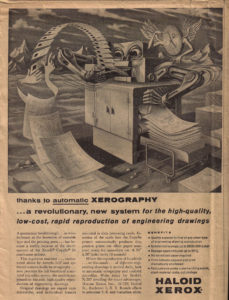
In the 1930s, Boris Artzybasheff began illustrating advertisements, many having an anthropomorphic representation to them. Examples of these anthropomorphic advertisements can be seen throughout his career such as the images he illustrated for Xerox when they wanted to promote their new copy machine. Artzybasheff designed an image containing a humanized copy machine happily spitting out hundreds of printed papers. Looking at the piece, the copy machine’s wide eyes appear to be concentrating on the stacks of papers shooting out of her half opened, smiling mouth. Behind the machine, lay stacks of unprinted paper waiting to be printed on. The advertisement gives the sense that the Xerox’s latest machine can make quick and easy work out of a big copy job.
In a time when consumers weren’t entirely comfortable with new technology, Artzybasheff believed that using anthropomorphism for advertising purposes would soften the consumers views of machinery and encourage them to jump on board with the post-war machinery era. In an article published in the Journal of Marketing Management, Patsiaouras, Fitchett, and Saren confer that “In a period of both technological and economic turmoil, Artzybasheff’s ‘man-saving’ anthropomorphic illustrations enticed potential customers to disengage their emotions from traditional methods of labour and catch the technology wave,” (2014).
Ultimately, these advertisements landed Artzybasheff long standing relationships with popular magazines such as Fortune, Life, and Time as a cover artist. From 1940 through 1965, Artzybasheff illustrated more than 200 covers for Time. His magazine illustrations included anthropomorphic images of countries, portraits of leading politicians, scientists, and athletes, and rising technologies.
Artzybahseff’s work in War Propaganda:
At the arrival of World War II, the American government began marketing propaganda in the form of war posters designed by popular artists. This marketing push held the hopes of forming a sense of comradery amongst the American people in order to bolster confidence and glorify their war efforts. Where other artists, such as Norman Rockwell focused their illustrations on idealistic and sentimental scenes of the American life, Artzybasheff’s images “focused on the representation of the enemy rather than the efforts of the federal government and defense industries to promote war bonds, national pride, frugality and recruitment of woman for factory labour,” (Patsiaouras et al., 2014). Examples of this can be found in his series called “Modern War Machines,” published in Life magazine in 1941. In this series, Artzybasheff illustrates war machines and humans morphed together into one object.
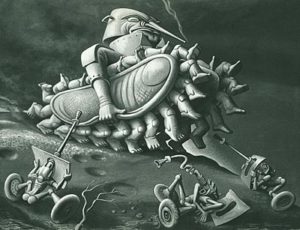
One of Artzybasheff’s well-known pieces from this series, entitled “Tank” was on exhibit at the lecture I attended, and instantly grabbed my attention. The illustration’s focus was what appeared to be a robot type being wearing a tank’s body, running over smaller humanized guns. The robot’s squinted eyes and smoking cannon for a nose gave it an angry appearance. The tanks’ body was a large thumb with two dozen sets of “forward-marching legs (those of German troops) make up the tank’s mechanized tread,” (Willaims, 2007). As if the body of the tank was too heavy to run in, the robot was holding it up with its arms. In the illustration, the massive tank was running over three smaller personified guns, hiding behind steel shields. The facial expressions on these smaller defeated guns made it obvious that they were terrified of the tank. I spent quite a bit of time, literally only minutes that felt like hours, staring at this illustration, feeling sad and broken as I watched the mammoth tank trample the defenseless guns.
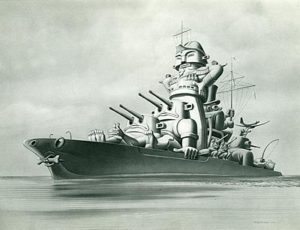
“Battleship” was another illustration from the same “Modern War Machines” series on display. This image focused on a mechanical Japanese soldier in uniform portraying the center stack of the ship. Humanized masts with cannons for eyes surrounded the soldier, appearing to be on the lookout for their next target as the ship floated through water. As intriguing as the piece of art was, no other images touched me like “Tank” did.
Artzybahseff’s work in America’s Post-War Consumer Culture:
In the post-war era of the 1950s, Artzybasheff began illustrating covers for Time with images of humanized technological appliances such as radios, telephones, and computers with the purpose of attracting consumers to spend money on superfluous household items. As consumers spent more money on such items, the demand also increased.
It can be said that Artzybasheff’s most famous collection of anthropomorphic machines were illustrated during this industrialized and technological time. This collection contains illustrations of humanized machines such as hydraulic presses, electric welders, and mills, to name a few which appear to be making more of the same humanized machines and industrial goods. Each machine shares the same common melancholy look in their eyes and turned down frown on their faces as they perform their routine tasks of replicating the same machine goods over and over. It is within this series, that Boris Artzybasheff allowed his opinions towards America’s industrialization to appear in his illustrations. In an article published in Interdisciplinary Humanities, R. John Williams acknowledges that “Artzybasheff’s work in the 1950s actually seems to reflect a deeper ambivalence about the potentially exploitative possibilities of the machine age,” (2007).
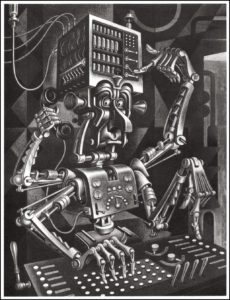
Coming from this era was a second piece of art on display that gabbed my attention from Artzybasheff’s lecture. Originally illustrated in 1952 for Esquire, “The Executive of the Future” was an illustration of a multi-armed robotic being that appears to be frantically doing multiple tasks at the same time, including answering a phone and typing on a futuristic keyboard. The frazzled looking being has circuits for brains located in his oversized head with numerous wires connected to it from other locations, not shown in the illustration. The robot’s tightly pressed lips and sideways downcast eyes give it the appearance of being overwhelmed or unhappy. It can be questioned whether this image represents someone in higher management or a regular middle-class position is unhappily trapped in a futuristic machine. I was drawn to this piece because of the sadness in the robotic being’s eyes. It reminded me of how myself and many others may feel overwhelmed and unhappy by the growing demands needing to be met in our jobs.
After attending the lecture and further researching his work, what really struck me as I explored Boris Artzybasheff’s artwork, was how many of his pieces are still relevant in today’s times even though they were illustrated over 50 years ago… Larger than life bullies forcing their way, their weight on those weaker than them? Society constantly being plugged in and turned out to what’s going on around them?
Works Cited:
Patsiaouras, Fitchett, & Saren. (2014). Boris artzybasheff and the art of anthropomorphic marketing in early american consumer culture. Journal of Marketing Management, 30(1-2), 117. Retrieved from https://search.proquest.com/docview/1498544109?accountid=14214
Williams, R. J.’I like machines’: Boris artzybasheff’s machine aesthetic and the ends of cyborg culture. Interdisciplinary Humanities, 24(1), 120-142. Retrieved from https://search.proquest.com/docview/1427741419?accountid=14214